
Women's health and pregnancy
36
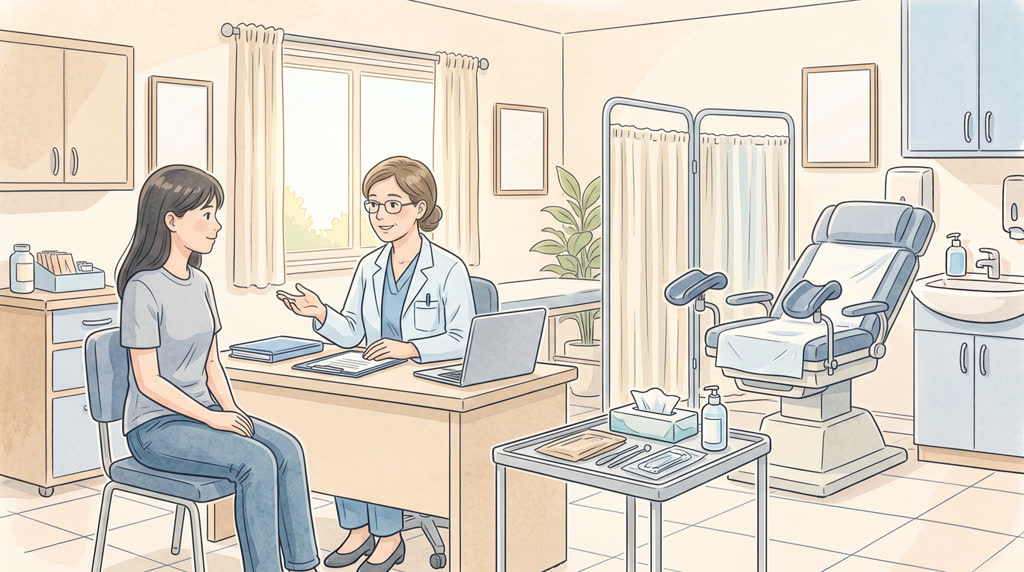
Gynecology checkupThe doctor asks about your health, examines you on the exam chair, and takes swabs if needed.⏱ usually 20 to 30 minutesFetal monitoring (CTG)A recording of your baby's heartbeat and the tightening of your womb. Two sensors on belts are placed on your belly. It is safe for you and your baby.⏱ usually 20 to 40 minutes, sometimes up to an hourIVF: embryo transferThe doctor places an embryo into the womb through a thin, soft tube. It is quick, with no cuts, and usually without anesthesia.⏱ the transfer itself usually takes 5 to 15 minutes; you are at the clinic for about 1 to 2 hoursFirst pregnancy appointmentYour first visit to a gynecologist for your pregnancy. The doctor confirms the pregnancy, asks about your health, and makes a care plan.⏱ the visit usually takes 30 to 60 minutes; test results come in 1 to 7 daysRoutine prenatal visitsRegular doctor visits during pregnancy. The doctor checks your health and your baby's growth.⏱ the visit usually takes 15 to 30 minutesGlucose test in pregnancyYou give blood on an empty stomach, drink a sweet glucose solution, and give blood again after one hour and after two. This checks how your body handles sugar.⏱ about 2 to 2.5 hours; results usually come in 1 to 2 daysPostpartum checkupA visit to the gynecologist after giving birth. The doctor checks how your body is recovering and answers your questions.⏱ the visit usually takes 20 to 40 minutesBreastfeeding consultationA specialist helps you get breastfeeding going. They show you how to latch your baby well and work through your difficulties.⏱ the consultation usually takes 1 to 1.5 hoursTreatment of cervical ectropionThe doctor treats a changed area on the cervix with radiofrequency, laser, cold, or a special solution. Healthy tissue grows back in its place.⏱ the procedure usually takes 10 to 20 minutes; healing usually takes 3 to 6 weeksCervical biopsyThe doctor takes a tiny piece of tissue from the cervix. It is studied under a microscope.⏱ the procedure usually takes 5 to 15 minutes; results usually come in 1 to 2 weeksEndometrial biopsyThe doctor passes a thin, flexible tube through the cervix into the womb and takes a little tissue from its lining. No cuts, and usually no anesthesia.⏱ the procedure usually takes 5 to 15 minutes; results usually come in 1 to 2 weeksBirth control consultationThe doctor helps you choose a way to prevent pregnancy that suits your health and lifestyle.⏱ the visit usually takes 20 to 40 minutesContraceptive implantThe doctor places a small, flexible rod under the skin on the inner upper arm. It releases a hormone and prevents pregnancy for several years.⏱ placement usually takes 5 to 10 minutes; it usually works for 3 years, some types longer. Check which you haveMenopause appointmentThe doctor helps you go through menopause more comfortably. They look at hot flashes, sleep, and mood, and suggest treatment if needed.⏱ the visit usually takes 30 to 40 minutes; test results come in 1 to 7 daysIntrauterine insemination (IUI)Prepared sperm is placed in the womb with a thin, soft tube on your ovulation days. This brings the sperm closer to the egg.⏱ the procedure itself usually takes 5 to 10 minutes; a pregnancy test about 2 weeks laterPelvic floor muscle trainingA specialist teaches you to find and strengthen the muscles at the bottom of the pelvis. They support the bladder, womb, and bowel.⏱ a session usually takes 30 to 60 minutes; a course usually lasts several weeks, with results after 2 to 3 months of regular practiceBreast specialist visitThe doctor looks at and feels your breasts and armpits. If needed, an ultrasound or mammogram is ordered.⏱ usually 15 to 30 minutes; you get the findings right awayPreparing for pregnancyThis is a doctor's visit before pregnancy. The doctor checks your health, orders tests, and advises you on how to prepare.⏱ the visit usually takes 20 to 40 minutes; test results are usually ready in a few daysCounting baby's movements at homeYou keep track of how often your baby moves. It is a simple way to notice whether your baby is doing well.⏱ usually up to 1 to 2 hours a day, as your doctor advisesChildbirth classesThese are classes for pregnant women and their partners. You learn how birth goes, how to breathe, and how to care for your baby.⏱ usually several classes of 1 to 2 hoursHaving a partner at the birthSomeone close to you stays with you during labor. They support you and help you breathe and change position.⏱ usually for the whole labor; the exact rules depend on the maternity hospitalCaring for perineal stitches after birthAfter birth, you may have stitches in the perineum, the area between the vagina and the anus. Simple care helps them heal faster.⏱ stitches usually heal in 2 to 3 weeks; dissolving stitches go away on their ownCervical pessary in pregnancyThe doctor places a soft silicone ring in the vagina. It supports the cervix and helps keep the pregnancy going.⏱ placing it usually takes 5 to 10 minutes; it is usually worn until 36 to 37 weeksAnti-D immunoglobulinThis is an injection for a woman with Rh-negative blood. It protects the baby from Rh disease in this and future pregnancies.⏱ the injection takes 1 to 2 minutes; afterward you are watched for about 30 minutesWhat to pack for the maternity hospitalThis is a list of things to take to the maternity hospital for you and your baby. It is best to pack your bag ahead of time.⏱ packing usually takes one evening; the bag is for 2 to 5 daysPostpartum depression screeningYou answer a short questionnaire about your mood and how you feel. This helps spot postpartum depression in time.⏱ usually 5 to 10 minutes; the doctor discusses the result right awayTreating thrush and bacterial vaginosisThis is treatment for common causes of itching and unusual discharge. The doctor takes a swab and chooses treatment.⏱ the visit usually takes 15 to 20 minutes; swab results are usually ready in 1 to 3 daysVisit for polycystic ovary syndrome (PCOS)The doctor finds out why your cycle is irregular and checks your hormones and ovaries. Then they choose treatment based on your goals.⏱ the visit usually takes 30 to 40 minutes; tests are usually ready in a few daysRemoving genital wartsThe doctor removes small growths on the genitals. They are caused by the human papillomavirus (HPV). They are removed with laser, radio waves, freezing, or burning.⏱ the procedure usually takes 10 to 30 minutes; healing usually takes 1 to 3 weeksA girl's first visit to the gynecologistThis is your daughter's first meeting with a gynecologist. Most often it is a talk and an outside exam, without instruments.⏱ usually 20 to 30 minutesOvulation inductionThe doctor prescribes pills or injections to help an egg mature. Ultrasound is used to watch the follicle grow.⏱ usually one attempt is one cycle; ultrasounds of 10 to 20 minutes several timesIVF: ovarian stimulation and injectionsYou give yourself hormone injections so that several eggs mature in the ovaries. The doctor watches this with ultrasounds and blood tests.⏱ injections usually last 8 to 14 days, with several ultrasoundsPessary for uterine prolapseThe doctor chooses and places a soft silicone ring in the vagina. It supports the uterus and the vaginal walls.⏱ fitting and placing it usually takes 15 to 30 minutesBreast self-examOnce a month, you look at and feel your breasts yourself. This makes it easier to notice changes and see a doctor in time.⏱ usually 5 to 10 minutes once a monthTreating a Bartholin's cystThere is a small gland at the entrance to the vagina. If its duct gets blocked, a cyst or abscess forms. The doctor opens it and makes sure it does not come back.⏱ the procedure usually takes 15 to 30 minutes; you usually go home the same dayEmergency contraceptionThis is a way to prevent pregnancy after unprotected sex. It is usually a pill. Sometimes the doctor places an IUD.⏱ the sooner, the better: usually within the first 72 hours, some methods up to 5 days