
Heart, lungs and nerves tests
39
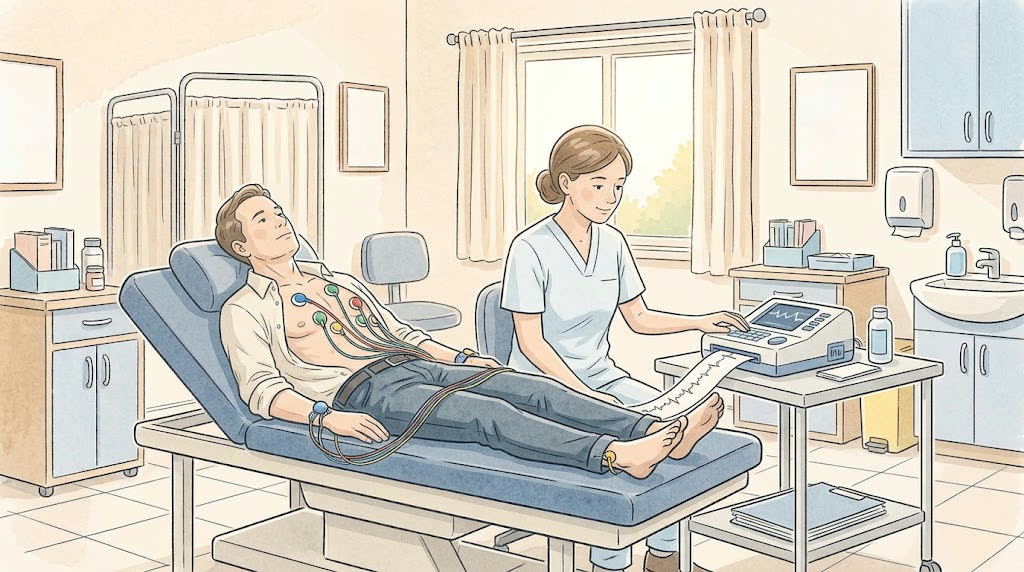
ECGA recording of your heart's electrical activity. Small pads are stuck on your skin. No electricity goes into you. It is safe.⏱ usually 5 to 10 minutesExercise ECGYour ECG is recorded while you walk on a treadmill or pedal an exercise bike. The effort is increased step by step.⏱ usually 30 to 60 minutes in the room; the exercise itself takes 8 to 15 minutesHolter monitorA small device on your belt records your ECG for a full day, sometimes 2 to 3 days, while you go about your normal life.⏱ 10 to 15 minutes to fit; usually worn for 24 hours24-hour blood pressure monitoringA cuff is put on your upper arm, with a small device on your belt. For 24 hours, it measures your blood pressure by itself, day and night.⏱ you usually wear the device for 24 hoursSpirometryA test of how much air you breathe in and how fast you breathe out. You breathe into the tube of a machine. It is safe and has no needles.⏱ usually 15 to 30 minutes, up to 45 minutes with an inhaler testEEG (electroencephalogram)A recording of your brain's electrical activity, using sensors on your head. No current is sent through the sensors. They only listen.⏱ usually 20 to 40 minutes; a sleep recording takes longerNerve and muscle test (EMG)The doctor checks how signals travel along your nerves and how your muscles work. Sensors on the skin, weak electrical pulses, and sometimes a thin needle are used.⏱ usually 30 to 60 minutesSleep study (polysomnography)While you sleep at night, your breathing, blood oxygen, pulse, brain activity, and movements are recorded. Sensors are stuck on your body. No needles.⏱ one night, usually from evening to morningECG for childrenA nurse records your child's heart activity with sticky pads called electrodes. It is quick, safe, and painless.⏱ usually 5 to 10 minutes; the report is often ready the same day24-hour blood pressure monitoring for teensYour teen wears a cuff on the upper arm for 24 hours. A small device on the belt measures blood pressure by itself, day and night.⏱ usually worn for 24 hours; the report is usually ready in 1 to 2 daysRheoencephalography (REG)A nurse puts sensors on your head and records a weak current through the tissues. This test is still used in some countries. From the recording, the doctor judges blood filling in the head's vessels.⏱ usually 15 to 20 minutes; the report is usually ready the same dayVideo EEG monitoringBrain activity is recorded through electrodes on your head for several hours or all night. Video is recorded at the same time, to compare the EEG with what is happening.⏱ from a few hours to 24 hours or longer, as your doctor decides; the report usually takes a few daysEEG for childrenA nurse puts a cap with sensors on your child's head and records brain activity. It is safe. The sensors send nothing, they only listen.⏱ usually 30 to 60 minutes; a sleep EEG takes longer; the report is usually ready in 1 to 3 daysEvoked potentialsThe doctor shows you pictures, plays sounds, or gives weak pulses to your arm or leg. Electrodes on your head record how fast the signal reaches the brain.⏱ usually 30 to 90 minutes; the report is usually ready in 1 to 3 daysSpirometry with bronchodilatorYou breathe out hard into a tube, then inhale a medicine that opens the airways, and breathe out again. This shows if your breathing improves with the medicine.⏱ usually 30 to 40 minutes; the report is often ready right away or the same dayBody plethysmographyYou sit in a clear booth and breathe into a tube. The device precisely measures your lung volume and how air moves through your airways.⏱ usually 20 to 40 minutes; the report is usually ready the same dayLung diffusion test (DLCO)You breathe in a safe gas mix and hold your breath for 10 seconds. The device shows how well your lungs pass gas into your blood.⏱ usually 15 to 30 minutes; the report is usually ready the same dayOvernight pulse oximetryAt home, you sleep with a small sensor on your finger. It records your blood oxygen and pulse all night.⏱ one night at home; the report is usually ready in 1 to 3 daysAnkle-brachial index (ABI)A nurse measures blood pressure on your arms and ankles. If it is much lower in the legs, the leg arteries may be narrowed.⏱ usually 15 to 20 minutes; results usually right awayTilt table testYou lie on a special table with safety straps. The table is tilted almost upright, and the doctor watches your blood pressure and pulse.⏱ usually 30 to 60 minutes, sometimes up to 90; the report is usually ready the same day24-hour esophageal pH monitoringA thin tube is passed through your nose into your food pipe and left for 24 hours. A device records how often acid from the stomach comes up into the food pipe.⏱ placing the tube takes about 15 minutes, and you wear it for usually 24 hours; the report usually takes a few daysEsophageal manometryA thin tube with sensors is passed through your nose into your food pipe. You take sips of water, and the device measures how the food pipe muscles work.⏱ usually 20 to 30 minutes; the report usually takes a few daysVideonystagmography (VNG)The doctor records your eye movements with special goggles that have cameras. Your eyes show how the balance organ in your inner ear works.⏱ usually 30 to 60 minutes; the report is often ready the same dayLong-term ECG monitor (7 to 14 day patch)A small monitor shaped like a sticky patch is placed on your chest. It records your ECG nonstop for 1 to 2 weeks while you live your normal life.⏱ it is usually worn for 7 to 14 days; results come a few days after it is removedSmartwatch ECG: how to record it and show your doctorSome smartwatches can record a single-lead ECG in about half a minute. You can save the recording and show it to your doctor.⏱ one recording usually takes about 30 secondsPeak flow at homeA peak flow meter is a small device you blow into hard. It shows how open your airways are right now.⏱ one measurement takes about a minute, usually morning and eveningSix-minute walk testYou walk along a hallway for 6 minutes at your own pace. The test measures how many meters you walked and how your pulse and oxygen change.⏱ usually 20 to 30 minutes including rest; the result is given right awayCardiopulmonary exercise testYou pedal a bike or walk on a treadmill while wearing a mask. The equipment checks how your heart works and how much oxygen you use.⏱ usually 45 to 60 minutes including setup; the exercise itself takes 8 to 12 minutesExhaled nitric oxide test (FeNO)You breathe out slowly into a small device. It shows whether there is a certain type of inflammation in your airways.⏱ usually 5 to 10 minutes; the result is given right awayMethacholine challenge testYou breathe in a substance in small, slowly rising doses and do a breathing test, called spirometry, after each one. This checks how sensitive your airways are.⏱ usually 1 to 2 hours; the result is given right awaySpirometry for childrenYour child blows into a tube, and a device shows how well their lungs work. Often there is a game on the screen to help.⏱ usually 15 to 30 minutes; the result is given right awayNailfold capillaroscopyUsing a special microscope, the doctor looks at the tiny blood vessels at the edge of your fingernails.⏱ usually 15 to 30 minutes; the report is ready right away or within a dayHome sleep apnea testYou take a small device home and sleep with it for one night. It records your breathing, oxygen, and pulse.⏱ one night at home; results usually come in a few daysBioimpedance body composition analysisA very weak current that you will not feel is passed through your body. The device works out how much fat, muscle, and water your body has.⏱ usually 5 to 10 minutes; the result is given right awayAnorectal manometryA thin soft tube, called a catheter, is put into your back passage. It measures how the muscles of your rectum and anus work.⏱ usually 30 to 45 minutes; results are given right away or in a few daysHydrogen breath test (SIBO, lactose)You drink a sweet solution and blow into a device every 15 to 30 minutes. The gases in your breath show how your bowel digests sugars.⏱ usually 2 to 3 hours; results are given right away or in a few daysHolter ECG for childrenSensors are stuck on your child's chest, and a small device records their ECG for 24 hours. Your child goes about a normal day.⏱ usually worn for 24 hours; results come in 1 to 3 daysObjective hearing test for babies (ABR, ASSR)Sensors are stuck on your baby's head, and quiet sounds are played into the ears. The device records the brain's response and shows how your baby hears.⏱ usually 30 to 90 minutes; the report is ready right away or the same dayElectroretinographyA device records weak electrical signals from your retina while you look at flashes of light.⏱ usually 30 to 90 minutes; the report is ready right away or in a few days