
← All services · Heart, lungs and nerves tests
Tilt table test
tilt table test · head-up tilt test · fainting test · orthostatic test
You lie on a special table with safety straps. The table is tilted almost upright, and the doctor watches your blood pressure and pulse.
For repeated fainting or near-fainting, to find the cause.
⏱ Duration: usually 30 to 60 minutes, sometimes up to 90; the report is usually ready the same day
Be sure to tell your doctor
How to prepare
- Food. Usually no food for 2 to 4 hours before the test. Check with the clinic.
- Medicines. Some medicines are sometimes skipped. Do not stop them on your own. Ask your doctor in advance.
- Someone with you. Better to come with someone. You may feel weak after the test.
- Clothing. Comfortable clothes, with no tight belt.
What to bring
- Your referral
- Past ECGs, Holter results, and echocardiograms
- A list of your medicines
- Someone to go home with
How it goes
- You lie on the table and are secured with straps
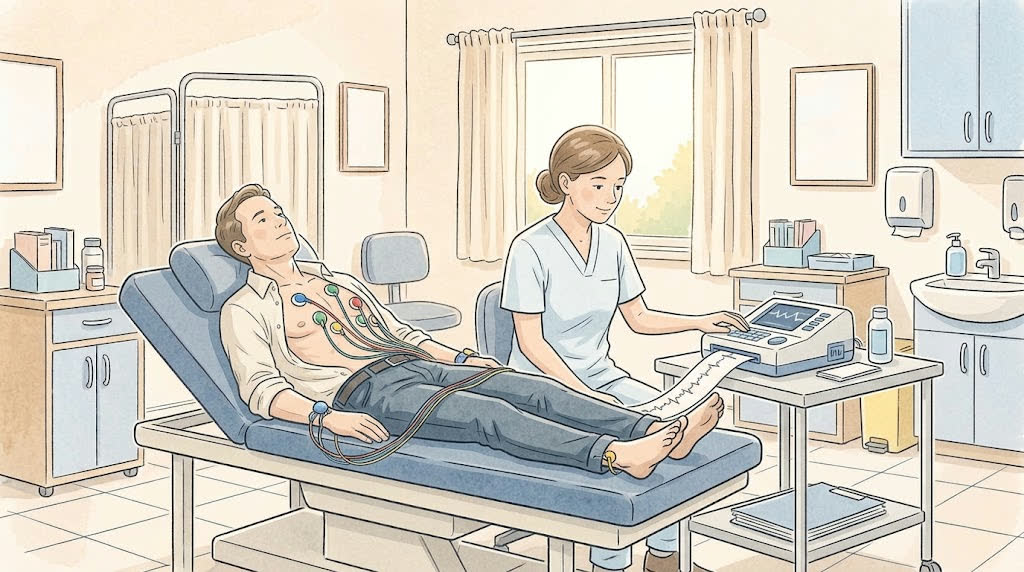
- ECG stickers and a blood pressure cuff are put on, sometimes an IV line too
- First, you lie quietly for a few minutes
- The table is slowly tilted almost upright
- You stand still on the table while the doctor watches your blood pressure and pulse
- Sometimes a medicine is given under the tongue and you are watched longer
- If you feel unwell, the table is lowered right away
What you'll feel
- Standing still can be boring
- You may feel weak, sick, or sweaty, like before fainting. Tell the doctor
- Sometimes people faint. This is expected. The table is lowered, and you come round quickly
Afterwards
- Lie down and rest until you feel better
- Better not to drive on the test day
- The report is usually ready the same day
Contact a doctor straight away if
- Chest pain, strong irregular heartbeats, or repeated fainting at home: call emergency services
Common questions
What if I faint?
You are strapped in, and the table is lowered right away. You usually come round in seconds, and the doctor is right there.
Why bring on a faint on purpose?
To see what happens to your blood pressure and pulse at that moment. This makes the cause easier to find.