
Medicine levels in blood (valproate, lithium, digoxin)
drug level test · therapeutic drug monitoring · lithium level · valproic acid level · digoxin level
This blood test shows how much of a medicine is in your blood right now. It tells your doctor if the dose is enough and not too high.
For medicines with a narrow safe range, after a dose change, with side effects, or if a medicine is not helping.
⏱ Duration: the blood draw usually takes 5 minutes; results usually come in 1 to 2 days
Be sure to tell your doctor
How to prepare
- Timing. The time of the draw matters most. Blood is usually taken just before your next dose. Your doctor will tell you the exact time.
- Morning dose. Ask your doctor whether to take your morning dose before or after the test. Do not skip or change a dose on your own.
- Regularity. For several days before the test, take your medicine exactly on schedule.
- Food. You usually do not need to fast. Check with the lab.
What to bring
- Your referral
- The time of your last dose, written down
- Your medicine, if the doctor said to take it after the test
How it goes
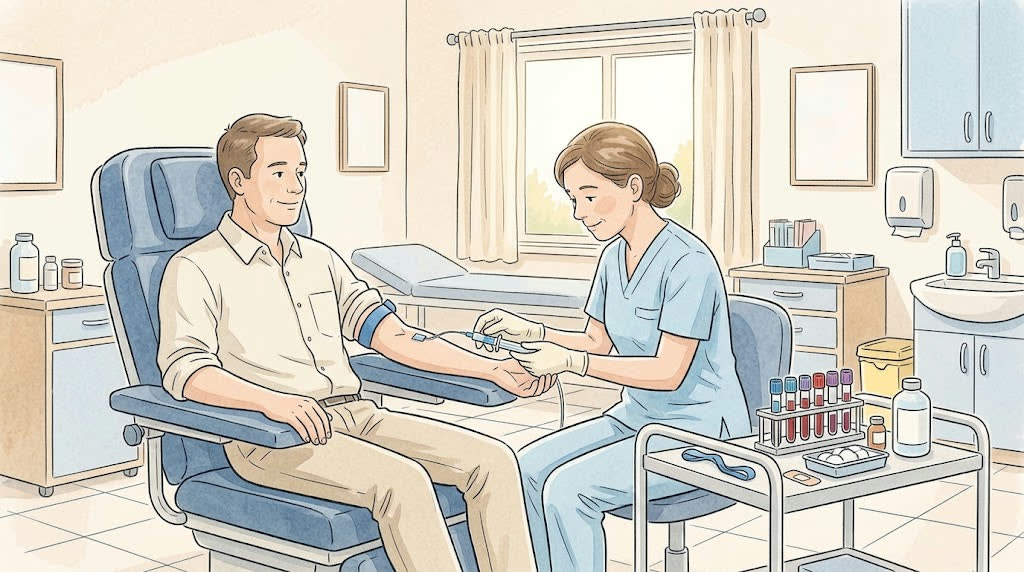
- Tell the nurse when you last took the medicine
- A band is tied above your elbow
- The skin is wiped with antiseptic
- Blood is taken from a vein into a tube
- The draw time is written on the referral
What you'll feel
- A quick prick, like a pinch
- Sometimes slight dizziness. Tell the nurse, and they will help you lie down
Afterwards
- Press the cotton pad for 3 to 5 minutes
- Take your medicine, if your doctor said so
- Results usually come in 1 to 2 days
- Only your doctor changes the dose based on the result
Contact a doctor straight away if
- Severe shaking, vomiting, diarrhea, unsteadiness, or confusion: see a doctor right away
- Fainting, seizures, or a very irregular heartbeat: call emergency services
Common questions
Why does the test time matter?
Right after a dose, there is a lot of medicine in your blood, and then it drops. Without the exact time, the result is easy to misread.
How often is this test done?
More often at the start of treatment and after a dose change, then less often. Your doctor will give you a schedule.