
Contrast-enhanced liver ultrasound
CEUS liver · contrast ultrasound · contrast-enhanced ultrasound · liver ultrasound with microbubbles
This is a liver ultrasound where a special contrast made of tiny gas bubbles is given into a vein. It lets the doctor see how blood fills spots in the liver.
To find out what a spot in the liver is, after it was seen on a regular ultrasound, CT, or MRI, and for follow-up after liver treatment.
⏱ Duration: usually 20 to 40 minutes including preparation; the report is usually ready the same day
Be sure to tell your doctor
How to prepare
- Food. Usually 4 to 6 hours without food. Still water is fine. Check with the clinic.
- Medicines. Do not stop anything on your own. Tell your doctor what you take.
- Kidneys. This contrast does not harm the kidneys, so kidney tests are usually not needed. Check with the clinic.
- Time. After the scan, you are usually asked to stay at the clinic for about 30 minutes.
What to bring
- Your referral
- Past liver ultrasound, CT, and MRI results
- A list of your medicines
- Wipes
How it goes
- The nurse puts a thin tube, a cannula, into a vein in your arm
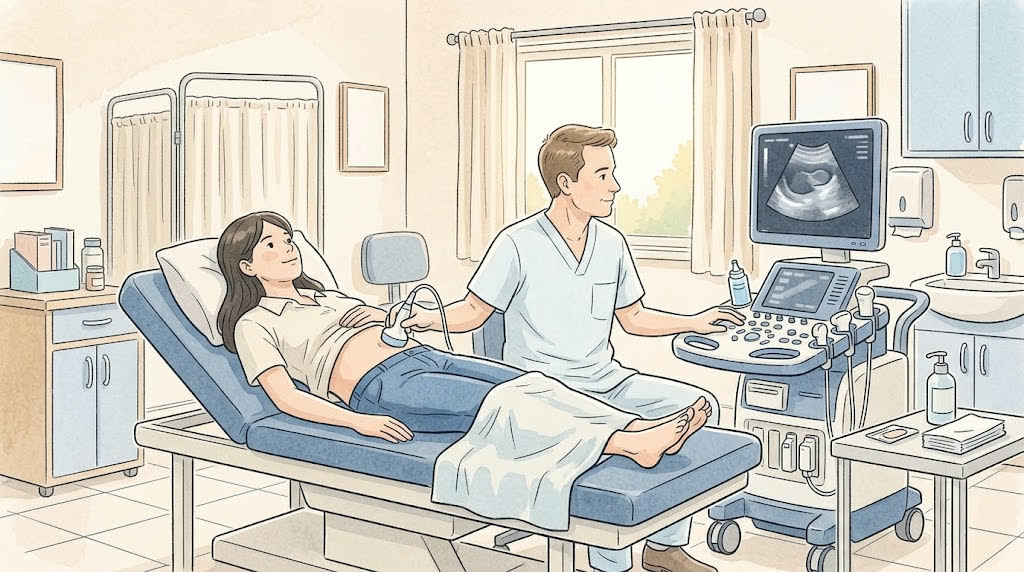
- You lie on your back, and gel is put on your belly
- The doctor first looks at the liver with regular ultrasound
- A small amount of contrast is given through the cannula
- The doctor watches the spot for a few minutes. Sometimes you are asked to hold your breath
- The cannula is taken out, and a cotton pad is pressed on the spot
What you'll feel
- A quick prick when the cannula goes in
- You usually do not feel the contrast. Sometimes there is mild warmth or a strange taste
- Rarely, a mild headache or nausea. Tell the doctor
Afterwards
- You usually stay under watch for about 30 minutes
- Then you can eat and go back to your day
- The report is usually ready the same day
- Your doctor will talk about the next plan
Contact a doctor straight away if
- A rash, itching, or swelling of the face or lips: tell the doctor right away
- Trouble breathing, chest pain, or severe weakness: call emergency services if you are already home
Common questions
Is this contrast the same as for CT?
No. It has no iodine. It leaves the body through the lungs when you breathe and does not strain the kidneys.
Can you be allergic to this contrast?
Rarely. That is why you are watched at the clinic for a short time after the scan.