
← All services · X-ray, CT, MRI
Head CT
head CT scan · brain CT · CT of the head
A CT scan shows your brain and skull bones in thin slices. It is fast, and usually no needle is needed.
After a head injury, if a stroke is suspected, for severe headaches, and to check the sinuses.
⏱ Duration: usually 5 to 10 minutes in the room; the scan itself takes less than a minute
Be sure to tell your doctor
How to prepare
- Without contrast. No prep needed. You can eat and drink.
- With contrast. You are usually asked not to eat for 3 to 4 hours. Water is fine. Sometimes you need a creatinine blood test. Check with your clinic.
- Metal. Take off earrings, hair clips, glasses, dentures, and hearing aids.
What to bring
- Your referral
- Past head CT and MRI scans
- Your creatinine test result, if you were asked
How it goes
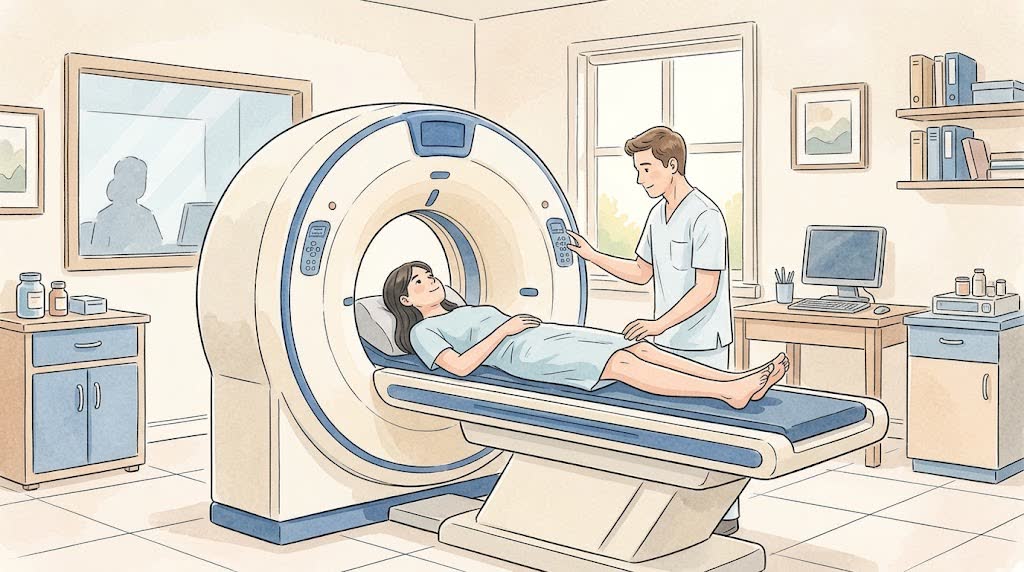
- You lie on your back with your head in a soft holder
- The table moves into a wide ring. Your head is inside, your body outside
- Stay still while the machine takes pictures
- If you have contrast, it goes into a vein and more pictures are taken
What you'll feel
- It does not hurt. The machine makes noise
- With contrast: a warm feeling and a metal taste. It passes in a minute
Afterwards
- You can go back to your day straight away
- After contrast, drink more water, unless your doctor said otherwise
- The report is usually ready in a few hours or 1 to 2 days. In an emergency, right away
Contact a doctor straight away if
- A sudden, severe headache, weakness in an arm or leg, a drooping face, or trouble speaking: call emergency services right away
- After contrast: itching, a rash, a swollen face, or trouble breathing. Tell the staff or call emergency services
Common questions
Which is better for the head, CT or MRI?
CT is faster and better for injuries and bleeding. MRI shows brain tissue in more detail. Your doctor chooses based on the question.
How much radiation is in a head CT?
More than an x-ray, but the dose is set for the task. If a CT is needed for a medical reason, the benefit is greater than the risk.