
Urologist visit
urologist appointment · urology consultation · prostate exam
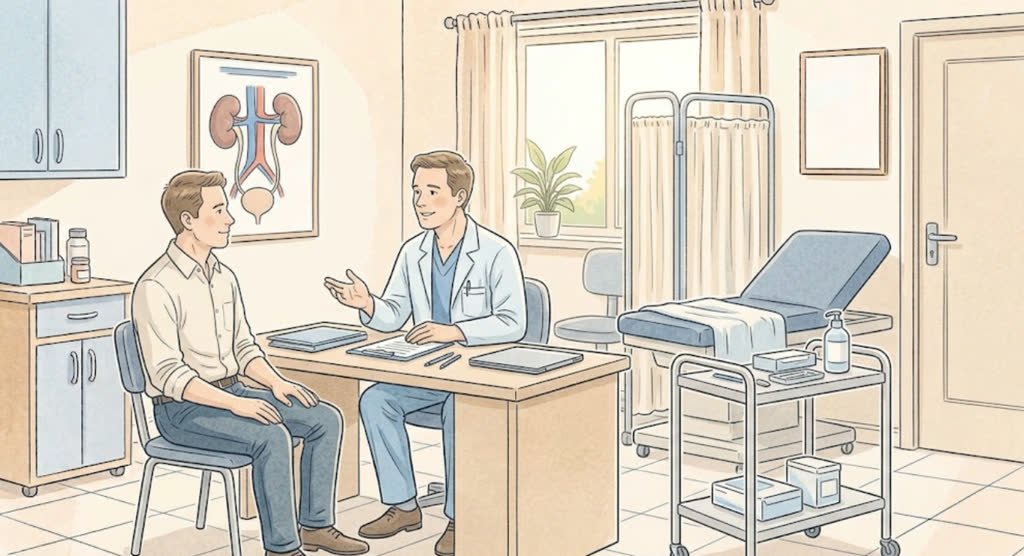
The doctor asks about your symptoms, examines your urinary and genital organs, and orders tests or an ultrasound if needed.
For frequent or painful urination, blood in the urine, pain in the lower back or groin, or erection problems. For men over 45 to 50, as a checkup.
⏱ Duration: usually 20 to 30 minutes
Be sure to tell your doctor
How to prepare
- Hygiene. A normal shower the evening before or in the morning.
- Bladder. If you will have a bladder ultrasound or a urine test, come with a moderately full bladder. Check with your clinic.
- PSA test. If you need a PSA test, blood is usually taken before the prostate exam. For 2 days before the test, avoid ejaculation and cycling.
What to bring
- Your ID
- Recent urine and blood tests, and PSA
- Ultrasound reports and past medical records
- A list of your medicines
How it goes
- The doctor asks about your symptoms
- The doctor looks at and feels your belly, lower back, and outer genitals
- In men, the prostate is usually checked with a finger through the back passage
- Women are examined on an exam chair, much like a gynecology exam
- Sometimes an ultrasound is done right away
- The doctor explains which tests and exams you need
What you'll feel
- The prostate exam is an unpleasant pressure for a few seconds, but usually not painful
- You may feel the urge to pass urine. This is normal
- Slow, calm breathing helps you relax
Afterwards
- You can go back to your day straight away
- Test results are usually ready in 1 to 3 days
Contact a doctor straight away if
- You cannot pass urine and your belly feels very full
- Fever with chills and pain in the lower back
- Blood and clots in the urine
- Sudden severe pain in a testicle: call emergency services right away. Every hour counts
Common questions
Does a prostate exam hurt?
Usually not. It is an unpleasant pressure for a few seconds. The exam is simple but very useful.
Should I see a urologist if nothing hurts?
Men over 45 to 50 are usually advised to have a checkup once a year. Many prostate problems cause no symptoms for a long time.