
← All services · X-ray, CT, MRI
Pituitary MRI
pituitary MRI · sella turcica MRI · pituitary MRI with contrast · dynamic pituitary MRI
A detailed MRI of the small gland at the base of the brain. Usually with contrast dye into a vein. No radiation.
For hormone problems with prolactin, growth hormone, or cortisol; for irregular periods; or for vision problems.
⏱ Duration: usually 20 to 40 minutes; the report in 1 to 3 days
Be sure to tell your doctor
How to prepare
- Contrast. If contrast is ordered, a creatinine test is sometimes needed. Usually no food for 2 to 4 hours. Check with the clinic.
- Metal. Take off everything metal: jewelry, watches, hair clips, piercings. Leave your phone and cards in the locker.
What to bring
- Your referral
- Hormone test results
- Past head and pituitary MRIs
How it goes
- You change and leave everything metal in the locker
- An IV line is put in a vein
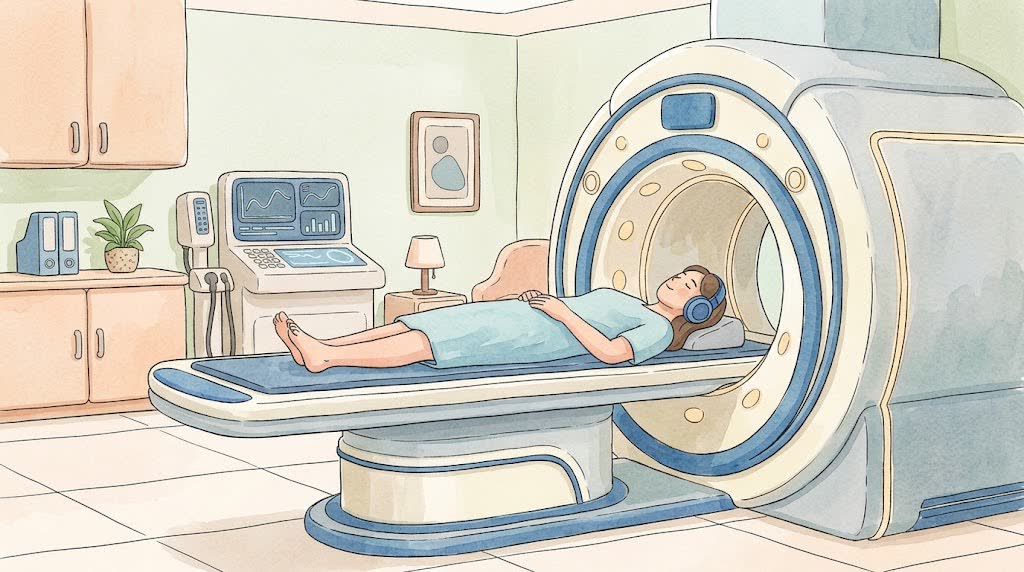
- You lie on your back, and your head is placed in a helmet-shaped coil
- The machine knocks loudly. You get headphones or earplugs
- Lie still. Staff talk to you over an intercom
- Contrast is given during the scan, and images are taken one after another
What you'll feel
- It does not hurt, but it is loud and tight
- Sometimes the area feels warm. That is normal
- With contrast: a cool feeling in the vein
Afterwards
- You can go back to your day right away
- After contrast, drink more water, unless your doctor said otherwise
- Take the report to an endocrinologist
Contact a doctor straight away if
- After contrast: itching, a rash, a swollen face, or trouble breathing. Tell the staff right away or call emergency services
Common questions
Is contrast always needed?
Most often yes. Small pituitary growths are hard to see without it.
If a growth is found, is it cancer?
Most often these growths are benign. An endocrinologist will decide what to do next.