
← All services · X-ray, CT, MRI
Breast MRI
breast MRI · contrast breast MRI · MR mammography
Images of the breasts in a magnetic field, with contrast dye into a vein. No radiation.
To clarify findings after a mammogram and ultrasound, for a high family risk, with breast implants, or before surgery.
⏱ Duration: usually 20 to 40 minutes; the report in 1 to 3 days
Be sure to tell your doctor
How to prepare
- Cycle day. Best on day 7 to 14 of your cycle. After menopause, any day. Ask your doctor.
- Contrast. If contrast is ordered, a creatinine test is sometimes needed. Usually no food for 2 to 4 hours. Check with the clinic.
- Metal. Take off everything metal: jewelry, watches, hair clips, piercings. Leave your phone and cards in the locker.
What to bring
- Your referral
- Past mammograms, breast ultrasounds, and MRIs
- A creatinine test, if asked
How it goes
- You undress to the waist and leave metal in the locker
- An IV line is put in a vein in your arm
- You lie on your stomach with your breasts in a special coil with openings
- Your head rests on a support, with your arms forward or at your sides
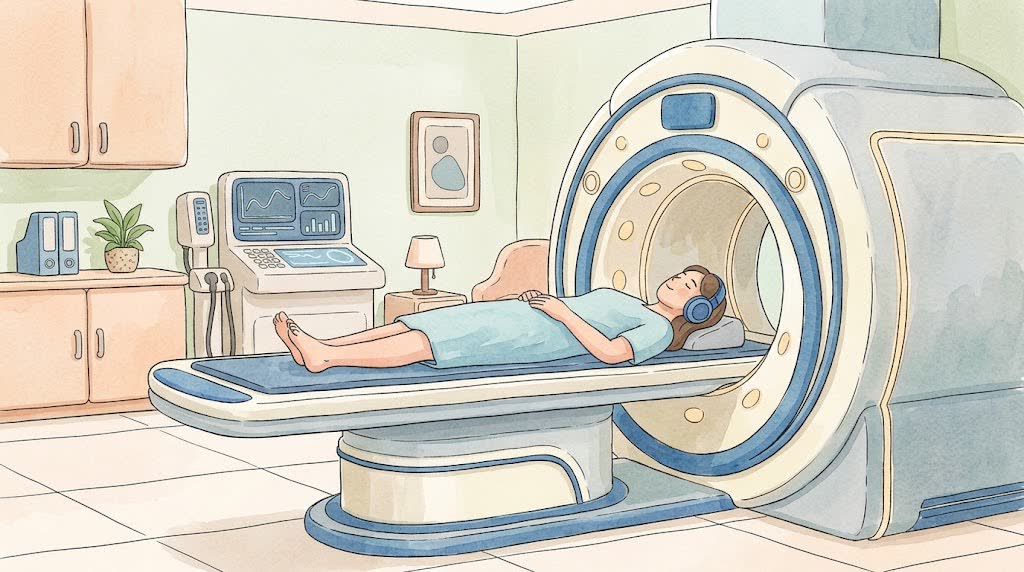
- The machine knocks loudly. You get headphones or earplugs
- Lie still. Staff talk to you over an intercom
- Halfway through, contrast is given and more images are taken
What you'll feel
- It does not hurt, but it is loud and tight
- Lying on your stomach can be uncomfortable. Say so, and pillows will be added
- With contrast: a cool feeling in the vein
Afterwards
- You can go back to your day right away
- After contrast, drink more water, unless your doctor said otherwise
- Take the report to a breast specialist
Contact a doctor straight away if
- After contrast: itching, a rash, a swollen face, or trouble breathing. Tell the staff right away or call emergency services
Common questions
Why does the cycle day matter?
In the second half of the cycle, breast tissue changes and takes up more contrast. The images are less accurate.
Can I breastfeed after contrast?
Usually yes. If unsure, ask your doctor.