
← All services · X-ray, CT, MRI
Abdominal and pelvic MRI
abdominal MRI · belly MRI · pelvic MRI · MRI of the abdomen
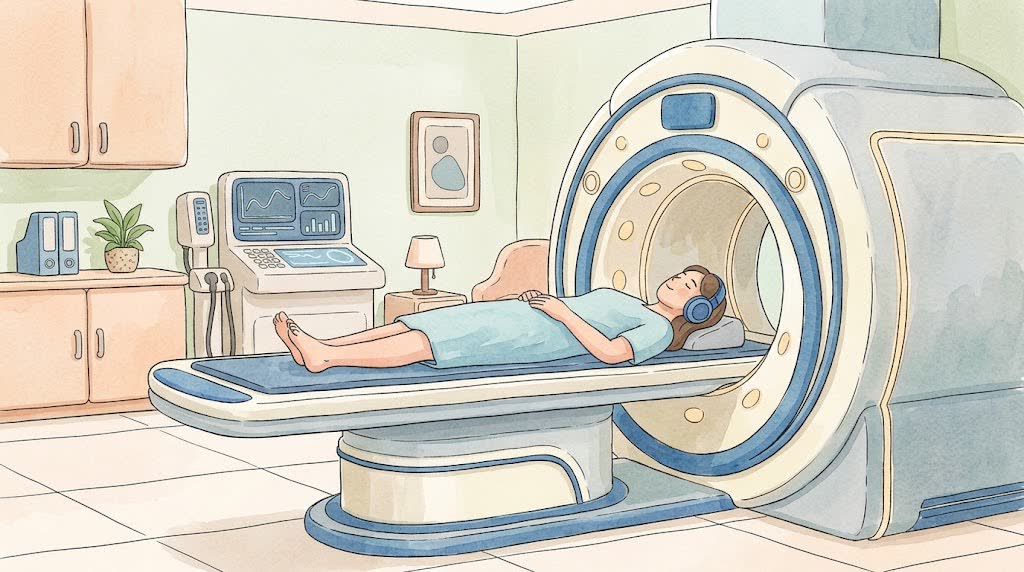
A machine with a strong magnet takes detailed pictures of the organs in your belly and pelvis. There is no X-ray radiation.
To look more closely at changes in the liver, pancreas, kidneys, or pelvic organs, if an ultrasound or CT did not give a full answer.
⏱ Duration: usually 30 to 60 minutes, longer with contrast
Be sure to tell your doctor
How to prepare
- Food. Usually no food for 4 to 6 hours before. Your clinic will give you the exact time.
- The day before. A light dinner without fizzy drinks, beans, raw vegetables, or dark rye bread. This means less gas in the bowel.
- Bladder. For a pelvic scan, you are sometimes asked to come with a fairly full bladder. Check with your clinic.
- Contrast. If contrast is planned, you are often asked for a recent creatinine blood test. It shows how your kidneys work.
- Metal. Do not wear jewelry. Remove glitter makeup and anything metal on your clothes.
What to bring
- Your referral
- Past ultrasound, CT, or MRI images and reports
- Your creatinine test, if contrast is planned
- Papers for your implant or pacemaker, if you have one
How it goes
- You answer a form about metal and your health
- You change and leave everything metal in a locker
- If contrast is needed, an IV is put into a vein
- Sometimes medicine is given so the bowel moves less
- You lie on your back, and a flat coil is placed on your belly
- The table slides into the scanner
- You are often asked to breathe in and hold your breath for a few seconds
- If contrast is needed, it is given in the middle of the scan
What you'll feel
- The machine knocks loudly. You get earplugs or headphones
- You need to lie still, which can be tiring
- Contrast sometimes gives a cold feeling in your arm
- You hold a call button. You can call the staff at any time
Afterwards
- You can eat and drink right away, unless the doctor says otherwise
- After contrast, drink more water that day
- The report is usually ready in 1 to 3 days
Contact a doctor straight away if
- After contrast: a rash, a swollen face, or trouble breathing. Tell the staff right away or call emergency services
Common questions
Why do I need to hold my breath during an abdominal MRI?
Belly organs move when you breathe. When you hold your breath for a few seconds, the pictures come out sharp.
Can I have an MRI with an IUD?
Usually yes. Most IUDs are safe with MRI. But be sure to tell the staff in advance.
Is MRI contrast dangerous?
It is usually well tolerated. Your kidneys are checked before contrast, and you should mention any allergy in advance.