
← All services · X-ray, CT, MRI
Coronary CT angiography
coronary CT angiography · CCTA · cardiac CT angiogram · CT scan of the heart arteries
Images of the heart's arteries on a CT scanner, with contrast dye into a vein. They show narrowing and plaques.
For chest pain, to check the heart arteries without a catheter, or when stress test results are unclear.
⏱ Duration: usually 20 to 40 minutes in the room including prep; the scan itself takes a few seconds; the report in 1 to 2 days
Be sure to tell your doctor
How to prepare
- Food. Usually no food for 3 to 4 hours. Water is fine. Check with the clinic.
- Coffee. On the day of the scan, you are usually asked to skip coffee, strong tea, and energy drinks. They speed up your pulse.
- Medicines. Do not stop your medicines on your own. Tell your doctor. They will decide. Sometimes a pill is given before the scan to slow your pulse.
- Blood test. A recent creatinine test is often needed.
What to bring
- Your referral
- A creatinine test
- ECGs and cardiologist reports
- A list of your medicines
How it goes
- An IV line is put in a vein in your arm
- Your pulse is checked. If it is fast, medicine is given to slow it
- ECG stickers are put on your chest
- Sometimes a pill or spray under the tongue is given to widen the arteries
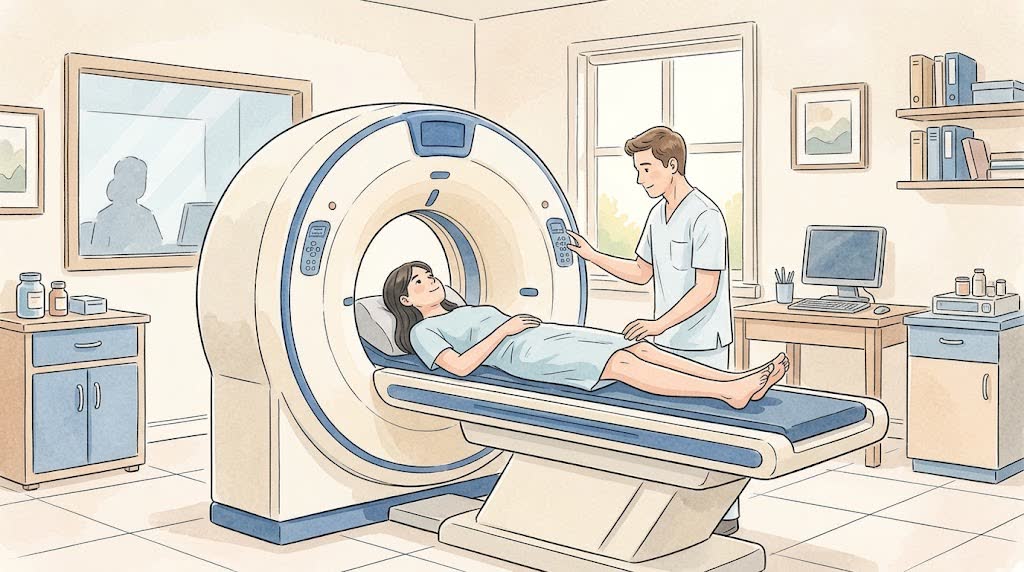
- You lie on the table and practice holding your breath on command
- Contrast is given and images are taken. Hold your breath for a few seconds
- After the scan, the IV line is removed
What you'll feel
- It does not hurt, apart from the IV line
- With contrast: a wave of warmth and a metallic taste
- The spray under the tongue may cause a mild headache
Afterwards
- Sit for 15 to 30 minutes under observation
- Drink more water, unless your doctor said otherwise
- The report usually comes in 1 to 2 days. Take it to a cardiologist
Contact a doctor straight away if
- Pressing chest pain for more than 15 minutes, shortness of breath, or cold sweat: call emergency services right away
- After contrast: itching, a rash, a swollen face, or trouble breathing. Tell the staff right away or call emergency services
- The IV site becomes very swollen and painful
Common questions
Can CT replace a regular coronary angiogram?
They are different methods. CT checks the arteries without a catheter. If a severe narrowing is found, a regular angiogram may be ordered.
Why slow the pulse?
The heart moves. With a slow pulse, the image is sharper.
Can I have coffee in the morning?
Usually not. It speeds up your pulse. Check with the clinic.