
← All services · X-ray, CT, MRI
Chest CT
chest CT scan · lung CT · CT of the lungs · low-dose CT
A CT scan shows your lungs in thin slices, in much more detail than a regular x-ray. Usually no needle is needed.
For pneumonia, a long-lasting cough, if something was found on an x-ray, and for early lung cancer screening in smokers.
⏱ Duration: usually 5 to 10 minutes in the room; the scan itself takes a few seconds
Be sure to tell your doctor
How to prepare
- Without contrast. No prep needed. You can eat and drink.
- With contrast. You are usually asked not to eat for 3 to 4 hours. Water is fine. Sometimes you need a creatinine blood test. Check with your clinic.
- Metal. Take off necklaces, pendants, and underwire bras. Clothes with no metal on the chest are best.
What to bring
- Your referral
- Past chest x-rays and CT scans, to compare
- Your creatinine test result, if you were asked
How it goes
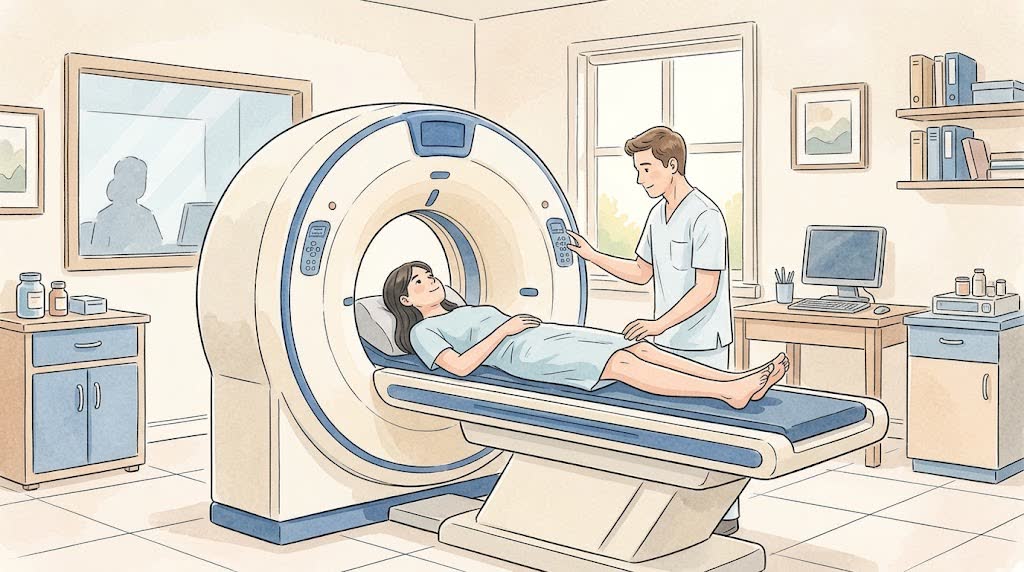
- You lie on your back with your arms raised above your head
- The table moves through a wide ring
- When told, breathe in and hold your breath for a few seconds
- If you have contrast, it goes into a vein and more pictures are taken
What you'll feel
- It does not hurt. The machine makes noise
- With contrast: a warm feeling and a metal taste. It passes in a minute
Afterwards
- You can go back to your day straight away
- After contrast, drink more water, unless your doctor said otherwise
- The report is usually ready in a few hours or 1 to 2 days
Contact a doctor straight away if
- If breathing is very hard or your lips turn blue, do not wait for your appointment. Call emergency services
- After contrast: itching, a rash, a swollen face, or trouble breathing. Tell the staff or call emergency services
Common questions
Why is a chest CT better than an x-ray?
A CT shows the lungs in slices and can find small spots that an x-ray misses.
What is a low-dose lung CT?
It is a CT with a lower dose, used to check smokers for lung cancer. Your doctor orders it based on your age and how long you have smoked.