
Prenatal blood screening
first trimester screening · double test · triple test · quad screen · prenatal blood screening
Blood is taken from the mother's vein to measure special proteins and hormones. Together with an ultrasound, this helps estimate the risk of some conditions in the baby.
For all pregnant women at set times: usually at 11 to 14 weeks, and sometimes in the second trimester.
⏱ Duration: the blood draw takes 3 to 5 minutes; results usually come in 2 to 7 days
Be sure to tell your doctor
How to prepare
- Timing. Blood is taken at the time your doctor set, often on the same day as the screening ultrasound or close to it.
- Food. Usually fasting, or a few hours after a light meal. Better to avoid fatty food the day before. Check with the clinic.
- Clothing. Wear a sleeve that is easy to roll up above the elbow.
What to bring
- Your referral
- Your ID
- Your ultrasound report
How it goes
- You fill out a form: weeks of pregnancy, weight, and height
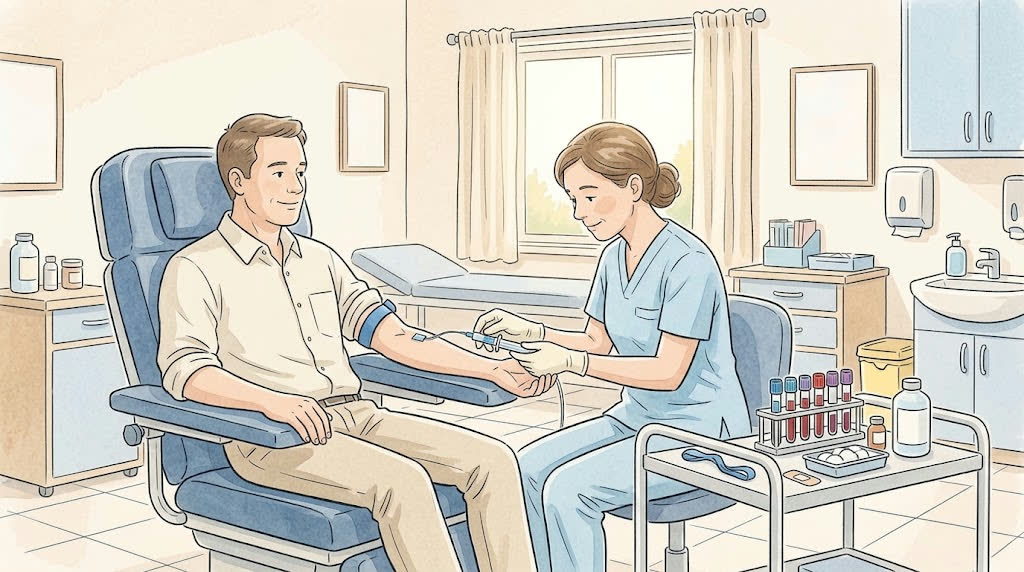
- You sit down and rest your arm on the armrest
- A band is tightened above your elbow, and the skin is wiped
- Blood is drawn into a tube
- The needle comes out, and a cotton pad is pressed on
What you'll feel
- A quick prick, like a pinch
- The test is safe for the baby
Afterwards
- Press the cotton pad for 3 to 5 minutes
- Results usually come in 2 to 7 days. It is a risk estimate, not a diagnosis
- If the risk is high, your doctor will offer more tests
Common questions
Does a high risk mean the baby has a condition?
No. It means more checking is needed. Most women with a high-risk result have a healthy baby.
Why does the exact week matter?
Protein levels change every week. If the dates are off, the risk estimate will be wrong.